

AI Hiring Technology in 2027: The 7-Layer Intelligence Stack
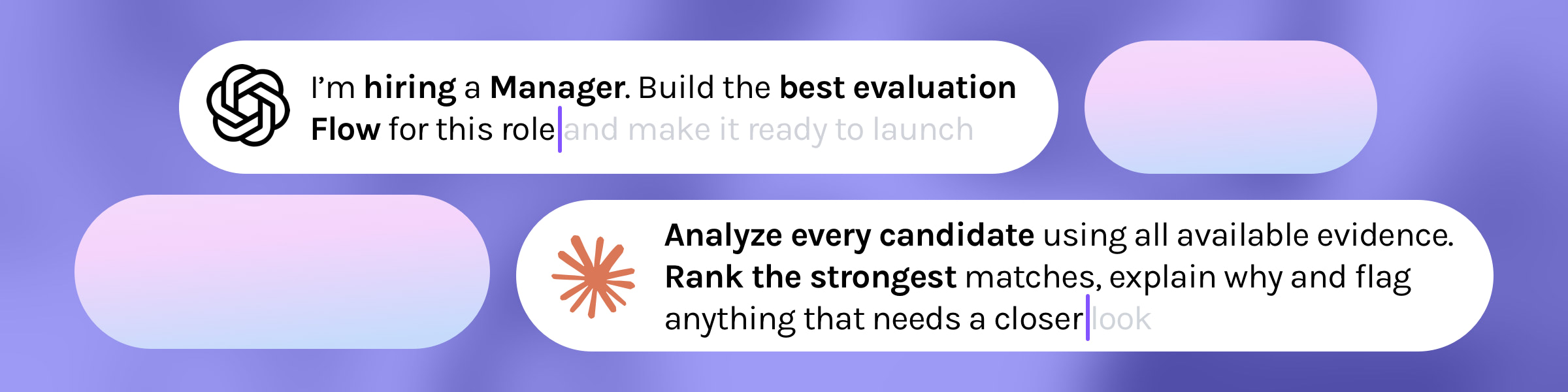
The next generation of hiring technology will not be defined by one AI model. It will be a connected intelligence stack that can reach current records, run structured workflows, collect better evidence, explain measured matches, and keep consequential decisions under human control.
The first wave of AI in hiring focused on content: writing job descriptions, summarizing resumes, generating interview questions, and answering routine candidate questions.
The next wave is operational.
AI assistants are beginning to connect to applicant tracking systems, HR platforms, assessment tools, reference workflows, verification sources, and people intelligence platforms. They can retrieve live context, use permitted tools, prepare actions, and organize evidence through natural language.
That shift is bigger than adding a chatbot to an ATS. It changes the architecture of the hiring stack.
SHRM's State of AI in HR 2026 research, based on responses from more than 1,900 HR professionals, found that 39% of organizations had implemented AI in HR and another 7% planned to do so during 2026. Recruiting was the leading HR use case, yet 56% of HR functions did not formally measure the success of their AI investments. The opportunity is therefore not simply more adoption. It is better-connected, better-governed, and more measurable adoption.
At the same time, the World Economic Forum reports that employers expect 39% of workers' core skills to change by 2030. Static job descriptions, resume keywords, and disconnected interview notes become weaker inputs when the work itself keeps changing.
The strategic question for 2027 is no longer, "Will HR use AI?"
It is:
What technology stack will make AI current, explainable, permissioned, evidence-backed, and useful enough for real people decisions?
The short answer: what should a 2027 hiring technology stack include?
A modern hiring intelligence stack has seven connected layers.
| Layer | What it does | Typical technology |
|---|---|---|
| 1. Systems of record | Holds authoritative identities, roles, stages, and employment records | ATS, HRIS, talent CRM, workforce systems |
| 2. Connected AI | Gives assistants controlled access to current data and tools | Model Context Protocol, APIs, OAuth, connectors |
| 3. Workflow orchestration | Coordinates multi-step evaluation work | AI agents, Flows, rules, prepare-and-confirm actions |
| 4. Skills intelligence | Translates changing work into structured capabilities and criteria | Skills taxonomies, role models, semantic matching, assessments |
| 5. Evidence collection | Collects richer, role-relevant signals | Work samples, adaptive questions, references, verifications, structured interviews |
| 6. Decision intelligence | Compares evidence and explains measured fit, gaps, and uncertainty | Evidence graphs, provenance, explainable scoring, semantic retrieval |
| 7. Governance and learning | Controls access, preserves human review, and improves future workflows | Permissions, audit trails, monitoring, post-hire signals, exit feedback |
The model is only one component. The durable advantage comes from how these layers work together.
1. Systems of record remain the foundation
The ATS and HRIS are not disappearing. Their role is becoming clearer.
They remain the systems that know which person is which, which role is open, which stage is current, who may access a record, and what has already happened. An AI model cannot reliably reconstruct that context from a pasted spreadsheet or a few copied profile summaries.
A copied document is a snapshot. A connected system is a live source of truth.
This distinction matters in hiring because small context errors can change the meaning of an answer:
- A score may belong to a different role or evaluation Flow.
- A reference may have arrived after the summary was copied.
- Two people may share the same name.
- A candidate status may have changed.
- A response may be visible to one role but restricted from another.
- A verification result may be a possible match rather than a confirmed conclusion.
By 2027, strong AI hiring platforms will not try to replace systems of record with an unstructured chat history. They will use those systems as governed foundations and add an intelligence layer above them.
Technology to watch: identity resolution, current-record retrieval, record-level permissions, event history, and reliable links between applicant, employee, reference, role, company, and workflow data.
2. MCP turns AI from a separate tab into a connected interface
Model Context Protocol (MCP) is an open standard for connecting AI applications to external systems. It allows a compatible assistant to discover defined resources, prompts, and tools instead of relying only on information pasted into a conversation.
In hiring, that can mean the difference between an assistant that knows general recruiting concepts and one that can work with an authorized ATS, assessment platform, people intelligence system, calendar, or HRIS.
Without a connection, an AI assistant can:
- Improve a job description
- Suggest interview questions
- Summarize text the user provides
- Discuss hiring strategy
With a well-designed connection, it may also be able to:
- Resolve the current role or evaluation workflow
- Retrieve authorized candidate records
- Read live assessment and reference evidence
- Prepare a structured evaluation Flow
- Compare people using one defined set of criteria
- Create a human-readable preview of a permitted action
The important qualification is well-designed.
MCP does not automatically make an integration secure, compliant, or least-privileged. It standardizes how AI applications and external systems communicate. Security still depends on the server, authentication, OAuth scopes, role permissions, tool design, approval rules, data handling, logging, and the policies of every platform involved.
OpenAI currently supports MCP-powered apps in ChatGPT, while Anthropic supports remote MCP custom connectors in Claude. Availability, write actions, and workspace controls differ by plan and may continue to change.
Generic AI, connected AI, and governed AI are not the same
| Capability | Generic AI assistant | Connected AI assistant | Governed hiring workflow |
|---|---|---|---|
| General hiring knowledge | Yes | Yes | Yes |
| Current company records | No | When authorized | When authorized and relevant |
| Live role and workflow context | No | Possible | Resolved before analysis |
| Tool use | No or limited | Defined external tools | Narrow, purpose-specific tools |
| Write actions | Not against the real system | May be possible | Prepared, previewed, permission-checked, and confirmed |
| Source separation | Depends on the prompt | Depends on returned data | Built into the evidence model |
| Human decision boundary | Informal | Platform-dependent | Explicit and auditable |
The chat window is not the breakthrough. The connection, evidence model, and governance are.
3. Agentic workflows move AI from drafting to doing
Generative AI produces content. Agentic AI can select tools and coordinate steps toward an outcome.
In recruiting, that does not need to mean an autonomous system making employment decisions. The more useful pattern is a bounded agent that can complete operational work while a person controls the scope and consequential actions.
For example, a recruiter may ask:
A connected agent could then:
- Resolve the company and role.
- Inspect the available assessment and reference capabilities.
- Translate the role into measurable criteria.
- Draft screening questions, work-sample tasks, and reference prompts.
- Configure the evidence that contributes to a role-specific score.
- Return the complete design for review.
- Create it only after explicit approval.
This is different from returning a generic questionnaire in prose. The output becomes a structured, usable workflow inside the platform.
The safest and most practical operating pattern for consequential work is:
Prepare → Preview → Approve → Execute
- Prepare: resolve the exact records, permissions, settings, and proposed change.
- Preview: show the user what will happen, what will not happen, and any validation issues.
- Approve: require an explicit confirmation of that exact action.
- Execute: recheck authorization and perform only the approved operation.
This pattern is especially important for bulk actions, invitations, status changes, publishing, deletion, and any workflow that affects a real person.
Technology to watch: tool-using agents, workflow state, reusable skills, structured outputs, validation, idempotency, approval gates, and audit-ready action history.
4. Skills intelligence replaces static role matching
Resume matching usually asks whether a candidate's words resemble a job description.
Skills intelligence asks a more useful set of questions:
- What work must be done?
- Which capabilities predict success in that context?
- Which skills can be demonstrated directly?
- Which claims are supported by experience or third-party evidence?
- Which requirements are missing, uncertain, or coachable?
- Which capabilities are becoming more important as the role changes?
This matters because employers expect 39% of workers' core skills to change by 2030, according to the World Economic Forum. The fastest-growing skills include AI and big data, networks and cybersecurity, technological literacy, creative thinking, resilience, and lifelong learning.
A static role profile ages quickly in that environment.
The 2027 model is a living capability map. It can connect:
- Role outcomes and responsibilities
- Required and preferred skills
- Work samples and job simulations
- Structured screening answers
- Assessments and Tests
- Reference observations
- Evidence from prior roles or projects
- Gaps that need interview follow-up
AI can help build and maintain that map, but the organization still needs to define what matters and whether each criterion is relevant, lawful, and supported by the work.
The best systems will also distinguish a skill claim from skill evidence.
A candidate saying "I am an excellent communicator" is a claim. A structured example, work sample, assessment response, and reference observation are different forms of evidence. They should not be flattened into one unsupported conclusion.
Technology to watch: dynamic skills ontologies, semantic role models, task-to-skill mapping, evidence-weighted matching, transferable-skill inference with review, and role-specific evaluation rubrics.
5. Adaptive assessment replaces one-size-fits-all forms
Traditional hiring workflows collect information in fixed steps. Every person receives the same form, whether the answer is complete, vague, contradictory, or unusually important.
Adaptive assessment changes the interaction based on the evidence already collected.
A useful follow-up does not simply ask more questions. It asks for the missing detail that makes an answer reviewable:
- "What was your specific responsibility?"
- "What changed because of your work?"
- "How did you measure the result?"
- "Can you give a concrete example?"
- "Was this based on direct observation?"
- "Which part of the claim are you able to confirm?"
This approach can improve several parts of the evaluation journey:
Conversational screening
Candidates can clarify requirements, experience, constraints, and examples without being forced through a rigid form that treats every answer the same.
Adaptive work-sample assessment
The system can request reasoning, assumptions, or a revision when a response needs context, while preserving a consistent evaluation rubric.
Conversational referencing
References can receive relevant follow-up questions when an answer is broad, incomplete, or important to a role-critical attribute.
Review-ready verification
Possible source matches can be organized with context and status instead of being treated as automatic facts.
The central design rule is source discipline. Candidate claims, assessment outputs, reference observations, public context, and verification signals should remain visibly distinct.
Adaptive AI should help collect clearer evidence. It should not infer protected characteristics, invent missing facts, or turn incomplete evidence into a negative conclusion.
Technology to watch: conversational assessment, adaptive follow-ups, structured extraction, multimodal work samples, fraud and authenticity signals, consent-aware public context, and source-specific summaries.
6. Evidence graphs will matter more than larger context windows
Retrieval-augmented generation can help an AI system find relevant text. Larger context windows can let it read more material at once.
Neither capability is enough on its own for serious people assessment.
Hiring evidence needs structure:
- Which person does this evidence belong to?
- Which role or Flow produced it?
- Who supplied it?
- When was it collected?
- Is it a claim, observation, score, source record, or model-generated summary?
- Which user may access it?
- Does another source support or contradict it?
- What is missing?
This is where evidence graphs and people graphs become important.
A graph can connect people, roles, companies, references, assessments, skills, verification sources, teams, managers, and workflow history. Semantic retrieval can find relevant material, while the graph preserves identity, relationship, source, and scope.
That architecture enables a more trustworthy answer.
Instead of:
A system can say:
The second answer is more useful because it is inspectable.
Explainable matching needs five components
- Defined scope: compare people inside one role-specific workflow or rubric.
- Visible criteria: show which attributes and evidence contribute to the result.
- Source provenance: distinguish candidate, assessment, reference, verification, and system-derived signals.
- Uncertainty: show missing, incomplete, weakly supported, and contradictory evidence.
- Human follow-up: convert gaps into questions rather than hidden assumptions.
A score can help prioritize review. It should not be presented as proof, a universal measure of quality, or an employment decision.
Technology to watch: knowledge graphs, entity resolution, vector and graph retrieval, evidence provenance, contradiction detection, cross-source corroboration, and explainable ranking.
7. Governance and continuous learning become product infrastructure
Governance cannot be added after the AI feature is launched. In hiring and employee workflows, it must shape the architecture.
The NIST AI Risk Management Framework organizes AI risk work around four functions: Govern, Map, Measure, and Manage. That logic is highly relevant to HR technology. Teams need to know the intended use, affected people, data sources, performance limits, access rules, review process, and response when the system behaves unexpectedly.
In practical product terms, governance includes:
- OAuth-based authentication where appropriate
- Least-privilege access and narrow scopes
- Live role and record-level permission checks
- Separation of read and write capabilities
- Clear previews before consequential actions
- Logs of tool calls, changes, and approvals
- Source provenance and confidence context
- Data minimization and retention controls
- Monitoring for errors, drift, and harmful bias
- A meaningful human review and escalation path
The regulatory direction reinforces this need. Under the EU AI Act, certain AI systems used for recruitment, candidate evaluation, worker management, or performance-related decisions may fall within high-risk categories when the Act's classification criteria apply. Following the 2026 AI Omnibus changes, the rules for Annex III high-risk systems are scheduled to apply from December 2, 2027.
That does not mean every AI feature used by an HR team is automatically high-risk. Classification depends on the system and use case. It does mean that transparency, relevant data, technical documentation, human oversight, monitoring, and clear responsibility are becoming practical buying requirements, not optional legal language.
The learning loop also needs governance
The strongest people intelligence systems will connect pre-hire evidence with what happens after hire:
- Which skills predicted useful contribution?
- Which requirements were overvalued?
- Which reference themes appeared later in work?
- Which team conditions helped people perform?
- Which workload or clarity patterns affected retention?
- Which exit themes should change future role design or evaluation?
This can make hiring workflows smarter over time, but only if organizations avoid turning historical decisions into unquestioned training labels. Past hiring outcomes may contain bias, inconsistent management, or poor role design. Continuous learning should help teams test criteria, not automatically repeat them.
Technology to watch: AI governance platforms, policy-aware permissions, evaluation and monitoring systems, human-review queues, audit trails, contribution intelligence, team signal analysis, and structured exit learning.
How the seven layers change a real hiring workflow
Consider a manager who needs to hire a Head of Customer Success.
In a disconnected stack, the process may look like this:
- Write a job description in one tool.
- Configure the ATS manually.
- Build an assessment in another platform.
- Copy candidate details into spreadsheets.
- Request references by email.
- Review scores without a common evidence model.
- Reconstruct the reasoning during the final meeting.
In a connected intelligence stack, the manager can begin with a natural-language brief:
The system can then:
- Resolve the company, role, and permitted workspace.
- Translate the brief into a structured capability model.
- Draft screening, work-sample, assessment, and reference steps.
- Define which evidence contributes to each measured attribute.
- Return the full Flow for review.
- Collect evidence consistently after approval.
- Explain each measured match with sources, gaps, and follow-up questions.
- Keep the shortlist, rejection, selection, and offer decisions with authorized people.
Natural language removes navigation friction. The stack underneath determines whether the result is reliable.
Five natural-language workflows that will become normal by 2027
The best prompts describe the outcome, scope, evidence rules, and decision boundary. They do not require the user to know internal tool names or record IDs.
1. Turn a role brief into an evaluation Flow
The value is not the generated text. It is the translation of business needs into a consistent workflow that can be reviewed, reused, and measured.
2. Prepare Checks for a group of people
A strong system resolves identities, validates the batch, confirms the Flow and permissions, and separates preparation from execution.
3. Build a source-separated evidence brief
This is more trustworthy than a generic profile summary because the answer preserves where every important signal came from.
4. Explain the highest measured matches within one Flow
The system can prioritize review without pretending that rank equals a final judgment.
5. Turn evidence gaps into a structured interview plan
This converts AI analysis into a better human conversation rather than an automated verdict.
How Jointl maps to the 2027 hiring intelligence stack
Jointl is built around the same connected-evidence model.
| 2027 stack layer | Jointl example |
|---|---|
| Connected AI | Jointl can connect to ChatGPT, Claude, and compatible AI applications through MCP, as well as to other systems through the Jointl API. |
| Workflow orchestration | Jointl Flows turn role or process requirements into repeatable evaluation journeys with collection, assessments, references, follow-ups, scoring, and summaries. |
| Skills intelligence | Skill-Based Matching connects role-specific capabilities to assessments, questions, references, and Matching Score attributes. |
| Adaptive evidence collection | AI-Adaptive Checks and Conversational Referencing collect deeper responses and relevant follow-up detail. |
| Evidence and relationship graphs | Multi-Layer People Intelligence, Single Profiles, cross-verified insights, and People Graph connect signals without erasing their sources. |
| Review-ready verification | Jointl Verifications organizes possible source matches and supporting context for human review. |
| Lifecycle learning | Glow Moments, Team Pulse, and Exit Intelligence connect hiring assumptions to contribution, team conditions, and departure patterns. |
The product principle is simple:
AI should help teams reach the evidence faster, understand it more consistently, and identify what needs closer review. It should not hide the evidence or replace accountable human judgment.
Explore Jointl integrations and API access.
What HR leaders should ask AI hiring vendors before 2027
A polished demo is not enough. Ask questions that reveal the architecture.
- Can the AI access current, authorized records, or does it rely on copied text and stale exports?
- How does the system distinguish candidate claims, assessments, references, verification signals, and AI-generated summaries?
- Can a reviewer see why a person received a score or rank?
- How does the product display missing evidence, contradictions, and uncertainty?
- Are comparisons restricted to people evaluated through the same criteria?
- Which actions can the AI take, and which require a preview and explicit approval?
- Are permissions checked live at the time of every read and write?
- What is logged, monitored, and available for audit or investigation?
- How are model, prompt, rubric, and workflow changes evaluated before release?
- Can the organization learn from post-hire contribution and exit patterns without automatically reproducing historical bias?
A vendor that cannot answer these questions clearly is selling an AI feature, not a dependable decision-support system.
A practical 90-day readiness plan
Organizations do not need to replace their full hiring stack at once.
Days 1-30: map one evidence-heavy workflow
Choose a role or evaluation process where teams already lose time switching between systems, rebuilding context, chasing references, or comparing inconsistent information.
Define:
- The decision to support
- The people and roles involved
- The criteria that matter
- The evidence sources that support each criterion
- The sources that should never be used
- The actions that require human approval
- The measures of success
Days 31-60: connect and test read-only use cases
Start with retrieval and explanation:
- Find the correct role or Flow
- Resolve one person without guessing
- Retrieve current evidence
- Separate facts from summaries
- Explain an existing score
- Identify missing and contradictory evidence
Test ambiguous names, missing data, restricted records, stale evidence, and conflicting sources - not only perfect demos.
Days 61-90: pilot one governed action
Introduce one narrow write workflow, such as preparing an evaluation Flow or creating a validated batch of Checks.
Require:
- An exact preview
- Clear validation errors
- Permission rechecks
- Explicit confirmation
- An audit record
- A rollback or recovery path where appropriate
Measure time saved, evidence coverage, reviewer consistency, candidate or reference experience, error rates, and the quality of human follow-up. Do not measure success only by how much content the AI generated.
FAQ: AI hiring technology, MCP, and people assessment in 2027
What is AI hiring technology?
AI hiring technology uses machine learning or generative AI to support recruiting work such as role design, candidate matching, screening, assessment, reference collection, evidence analysis, scheduling, and workflow automation. The strongest systems preserve source context, explain their outputs, and keep consequential employment decisions with authorized people.
What is MCP in hiring?
MCP stands for Model Context Protocol. It is an open standard that lets compatible AI applications connect to external tools and data through defined operations. In hiring, an MCP connection can give an assistant a permissioned path to an ATS, HRIS, assessment platform, or people intelligence system instead of relying on pasted text.
Is MCP the same as an API?
No. An API defines how software systems exchange data or perform operations. MCP provides a standardized, model-readable way for AI applications to discover and use resources, prompts, and tools that may be backed by those APIs. Many MCP servers use an existing API underneath.
Does MCP make an AI hiring integration secure?
Not by itself. Security depends on the implementation, including authentication, OAuth scopes, server trust, tool design, permissions, approvals, logging, data handling, and the AI provider's controls. Organizations should connect only to trusted servers and use the smallest useful scope.
What is agentic AI in recruiting?
Agentic AI can select tools and coordinate several steps toward a recruiting outcome, such as resolving a role, designing an evaluation workflow, gathering authorized evidence, and preparing an action. Responsible use keeps the scope bounded and requires human approval for consequential changes and employment decisions.
What is skills intelligence?
Skills intelligence is the structured understanding of which capabilities a role requires, how those capabilities relate to tasks and outcomes, and what evidence supports them for each person. It goes beyond keyword matching by connecting role criteria to assessments, work samples, experience, references, and identified gaps.
What is evidence-backed candidate assessment?
Evidence-backed candidate assessment evaluates people using structured, role-relevant sources rather than one resume, one interview, or one opaque score. Sources may include screening answers, work samples, assessments, references, and permitted verification context. Each source should remain visible, and missing evidence should not be treated as negative evidence.
Can AI rank candidates?
AI can help calculate or return measured ranks within a defined role-specific workflow. A responsible platform should show the criteria, evidence, gaps, and uncertainty behind that order. Rank should support human review, not be treated as an automatic shortlist, rejection, or hiring decision.
Will AI replace recruiters and hiring managers?
AI is more likely to change how their work is organized. It can reduce repetitive navigation, drafting, data collection, and summarization. Recruiters and hiring managers remain responsible for context, relationships, judgment, lawful process, candidate communication, and consequential decisions.
What should a 2027 hiring technology stack include?
It should connect authoritative systems of record, controlled AI access, agentic workflow orchestration, skills intelligence, adaptive evidence collection, explainable decision support, and governance. It should also create a learning loop between hiring evidence, employee contribution, team conditions, and exit patterns.
The 2027 advantage will not come from the model alone
Natural language will become a common interface for hiring and people operations. Managers will ask for outcomes in the language they already use:
- Design this evaluation Flow.
- Resolve these people.
- Prepare these Checks.
- Explain the measured matches.
- Show which evidence supports each conclusion.
- Turn the gaps into interview questions.
But a fluent answer is not the same as a trustworthy system.
The organizations that gain the most from AI will build the layers underneath the conversation: current data, controlled connections, structured workflows, skills intelligence, source-separated evidence, explainable matching, and human-governed action.
The future of AI hiring is not a chatbot that talks confidently about people. It is a connected evidence system that helps people decide what deserves closer review.
Connect your people stack to Jointl, then create your Jointl workspace and start with one clear, evidence-backed Flow.
Primary sources and further reading
- Model Context Protocol: What is MCP?
- OpenAI: Developer mode and MCP apps in ChatGPT
- Anthropic: Get started with custom connectors using remote MCP
- SHRM: The State of AI in HR in 2026
- World Economic Forum: Future of Jobs Report 2025 - Skills Outlook
- NIST: Artificial Intelligence Risk Management Framework
- European Commission AI Act Service Desk: Employment use cases
- European Commission: AI Omnibus enters into force